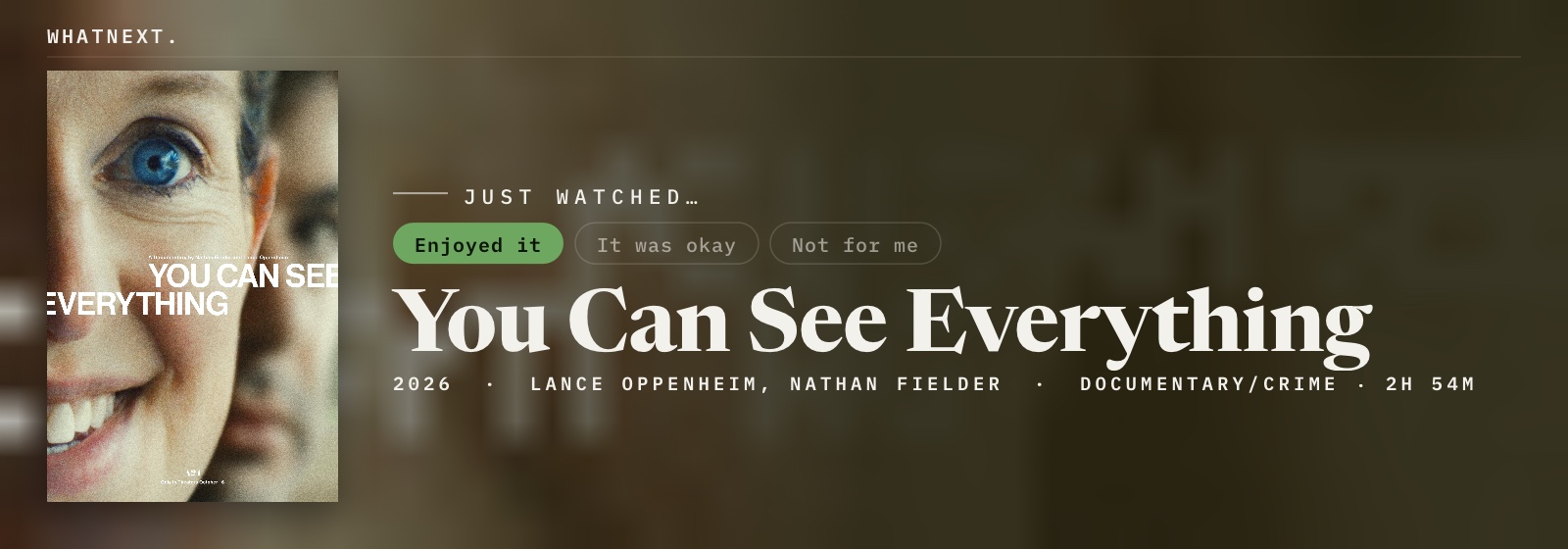
I don't watch many documentaries, which made You Can See Everything (2026) an especially interesting watch for me. Co-directed by Nathan Fielder and Lance Oppenheim, the A24 release begins in the final weeks before disgraced Theranos founder Elizabeth Holmes reports to federal prison, with Fielder moving into the rented Del Mar, California beach house she shares with her partner Billy Evans. Rather than staying a straightforward pre-prison profile, the cameras stick around well past her intake date and turn the project into something stranger, blurring traditional documentary filmmaking with Fielder's self-reflexive social experiments.
What Worked
Overall, the movie is interesting and thought-provoking. The first half is paced very well, settling into the odd dynamic inside the house as Holmes prepares to leave for prison. Early on, it is easy to approach it as a standard character study with Fielder embedded in the couple's daily routine, though for me the movie got noticeably better once I stopped thinking about it as an Elizabeth Holmes documentary and took it on its own terms.
What really landed was watching Nathan eventually confront his own possibly compromised objectivity. The second half feels noticeably more sympathetic toward Holmes than the first, and the film lets you see that shift happening on screen. In one scene, Nathan and Amanda Seyfried read through tweets and both insist, "She would never say this," even though Nathan only knew her for a month and Amanda had never met her. (Granted, this happens after Billy admits to making things up, so there was some merit to their skepticism.)
Later, Amanda questions Nathan's objectivity directly, which reframes an earlier moment in the film. When Elizabeth first invites Nathan to swim in the ocean, the edit makes it look like a refusal as he rattles off excuses, only for the movie to reveal later that he did go swimming and that they looked like they were having fun. Moments like that make the film play more like a drama or a reality TV show, with Nathan operating as much as a subject as a filmmaker.
The movie also succeeds by refusing to hand the audience a tidy verdict on Holmes's motivations, since no one can know them for sure. It leaves open whether she is the ultimate manipulator using the documentary to look unaware of the machinations around her, or whether she really is unaware. In the same way, it is possible that Billy and Elizabeth played up their dynamic for the cameras so viewers would buy her version of events as someone who simply stays out of the details. We will never truly know, and the film is smart to leave that ambiguity intact.
What Didn't Land
Once Holmes goes to prison, the pacing drops off and the movie drags a bit a few times. With Elizabeth largely unseen, the film leans on reenactments with Amanda Seyfried, which makes the second half feel like a different movie altogether. Because roughly half the runtime takes place after she is already behind bars, it stops feeling like a documentary about Elizabeth Holmes, or even about the weeks leading up to her sentence.
Amanda Seyfried's involvement also felt a bit odd to me. Seyfried, who previously portrayed Holmes in the dramatized streaming series about Theranos, appears in a way that left me unsure whether we were seeing the real her or an act, and that uncertainty took me out of the movie a bit. In one exchange, she gets weirdly defensive when Holmes mentions disliking how she was portrayed in that series, arguing that fiction does not have to be accurate.
Final Thoughts
Even in its direction, You Can See Everything plays differently from a standard documentary. I typically watch movies alone, but this one hits better when you have people to discuss it with afterward, because everyone walks away seeing something different. My friends and I disagreed on plenty of things, though we did agree that it didn't feel like a documentary.
In fact, the discourse this movie sparks may end up being more interesting than the movie itself, and it was already an interesting movie. Writing down my thoughts here made me realize that although I enjoyed it, the more I think about the movie, the less concrete any of my thoughts on it feel, which is a bit of a shift from my initial reaction on TikTok, where I said I liked it quite a bit.
Thoughts on Cast
- Nathan Fielder: Felt more like a subject at points than the documentarian, especially with reveals like the ocean swim footage.
- Elizabeth Holmes: Enigmatic; she could be either the most manipulative person ever or exactly who she says she is.
- Billy Evans: Felt dodgy and controlling at times, and a few times not.
- Amanda Seyfried: Seemed far too invested, though my friends disagree with me on this point.
Stray Observations
- The reality TV feel: At times it felt like watching a reality TV show where each person played up parts of their personality to make for a better watch.
- Getting paid for the documentary: A major plot point later in the film involves Billy negotiating a deal to get paid from the movie, allegedly behind Elizabeth's back. I don't really buy that she was completely in the dark since she conveniently leaves the room when the time comes, though the film leaves a question mark around whether she was involved. It also raises a fair point: documentaries don't usually make much money, yet this one feels marketed and sometimes directed like a commercial feature, so why shouldn't they be paid for their story and appearance? And if Nathan was paid too, doesn't he have just as much incentive to make it more entertaining to turn a profit? I'm not totally sure where I land on that.
If You Liked This, Try These
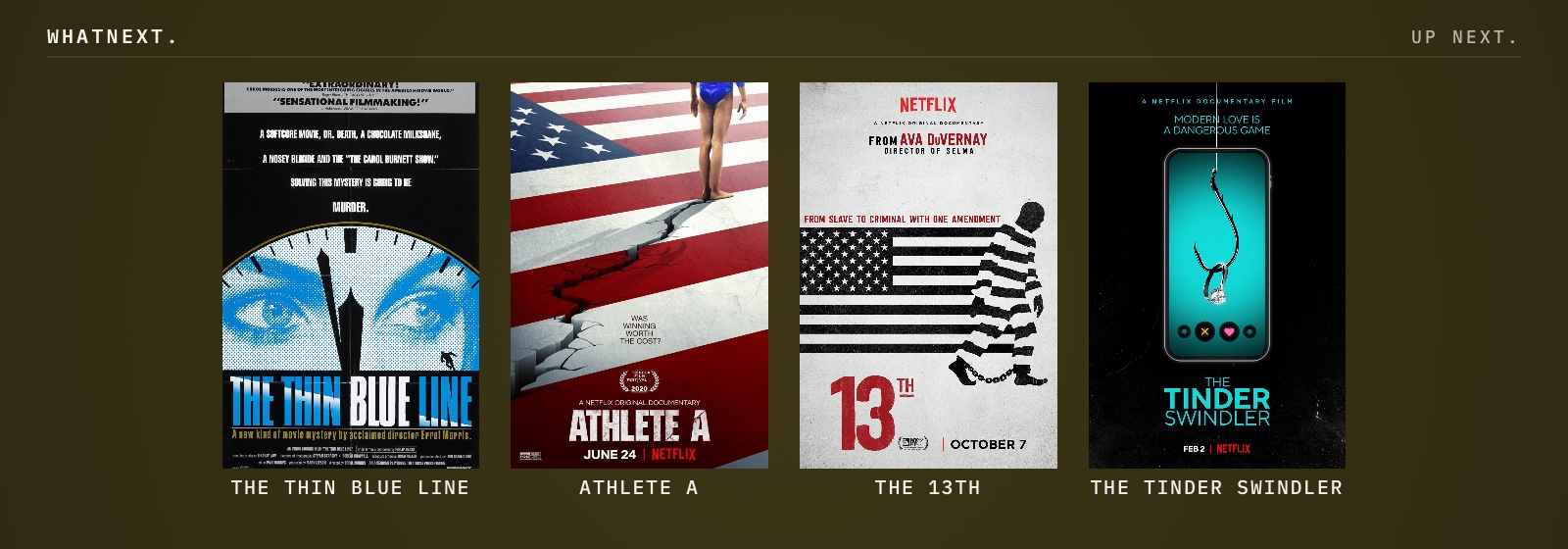
WhatNext.'s recommendation engine seeded directly from You Can See Everything, pulling four documentaries that explore crime, media performance, and how truth gets shaped on camera:
The Thin Blue Line (1988) is Errol Morris's landmark investigation into the wrongful conviction of Randall Dale Adams for a 1976 Dallas police murder. Using stylized reenactments and conflicting interviews, it turns a true-crime inquiry into a study of how truth gets constructed on camera, making it a natural companion if you liked the self-reflexive side of You Can See Everything.
Athlete A (2020), directed by Bonni Cohen and Jon Shenk, follows the Indianapolis Star reporters who broke the story of Larry Nassar's abuse inside USA Gymnastics. It shifts the focus from an enigmatic individual to institutional failure and the mechanics of an investigation.
The 13th (2016), from director Ava DuVernay, examines the intersection of race, criminal justice, and mass incarceration in the United States through the loophole in the Thirteenth Amendment. It is a broader, essayistic look at systems of power and public narrative.
The Tinder Swindler (2022), directed by Felicity Morris, tracks a con artist who posed as a billionaire diamond mogul to defraud women across Europe, told through the victims who teamed up to expose him. If the manipulation and blurred public persona aspects of You Can See Everything hooked you, this one leans directly into that tension.
From the same recommendation pool, 1971 (2014), Johanna Hamilton's documentary about the citizens who burgled an FBI office in Media, Pennsylvania to expose illegal surveillance, tied The Tinder Swindler on quality score and serves as the bonus watch.